Every release, told plainly.
MADRE ships often, and every release changes something you notice. Here is what matters in each one, without jargon. The full technical record lives in the repository’s CHANGELOG.
-
MADRE has a home, and explains failures better.
The product’s home is madre.run: reports arrive there, with a form that needs no account and GitHub one click away. And when something fails, the room gives a support code, a clear remedy and the cause, not a number.
- madre.run, the product’s home. Automatic reports go to madre.run instead of a makeshift address, and the old one keeps answering for rooms already installed. For people, a form with no account, and GitHub one click away.
- A code to ask for help. Every MU/TH/UR condition has its support code, from MU-001 to MU-054: the one you read out when you ask for help. And the log downloads as a CSV.
- Remedies in Spanish, and buttons where there were commands. The comments on the remedies are in Spanish with the names you see on screen, and eight are now solved from CONNECTIONS, on the agent in question.
- Causes, not numbers. “Code 143” now reads “something asked it to stop”. A failed turn first says what happened and then, separately, what the agent’s program answered.
- Alerts you can close. Each row of the log is dismissed with its ×, or all at once, without erasing the history. The MU/TH/UR badge counts only what is still open.
- Image Studio and PLAYWRIGHT, fixed. Image Studio finds the Gemini key MADRE stores, on Linux too, and PLAYWRIGHT connects: a separator was missing from the command that launches it.
- What the testers found. PULSE_LANGUAGE switches the whole interface, EYECAT and condition severity speak Spanish, and entering NOSTROMO no longer leaves focus on EXIT.
-
Transparent end to end.
You can read what MADRE says on your behalf, see what leaves your machine and work in several conversations with one memory. And the room speaks Spanish.
- The core, in the open. The document MADRE writes on your behalf each turn can be read in full from NOSTROMO, along with the exact command that delivers it. Environment variables show only their names.
- What left this machine. Eight addresses, each with what it carries and where it switches off, plus a log of every request. Never a body, a header or a value.
- Many conversations, one memory. Open separate threads on the same project: they all feed the same archive.
- Memory shows when it is used. Every answer says which memory notes it used, and search also brings the ones the room tends to use together.
- EYECAT and aberrations. An independent watcher finds notes that contradict each other; what you mark as false stops circulating.
- Three maturity tests. MU/TH/UR measures whether the archive answers what the project asks, whether it contradicts itself and whether the local model is ready, always against a control.
- Privacy and permissions. Keys, tokens, emails and personal paths are masked before they are stored. And typing #3 or #4 goes through the same override as clicking.
- Modules and the bridge. Modules update with your click, community modules come in through + ADD A MODULE, and agents are installed and signed in from the room.
- Spanish by default. More than a thousand of the room’s sentences in Spanish, with English one button away.
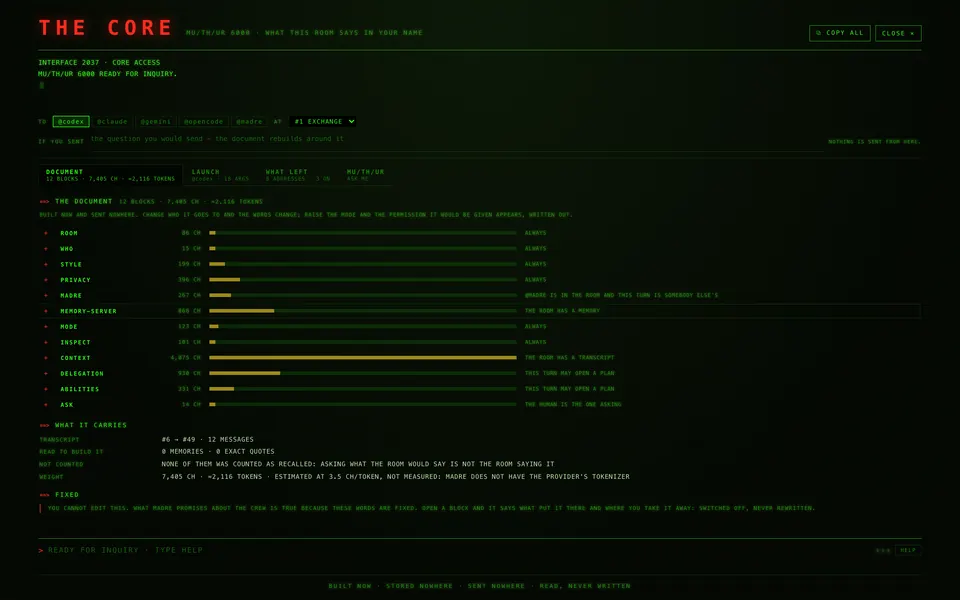
The core, new in 0.4.0: the document MADRE writes on your behalf, block by block. MADRE 0.4.0 running locally · Sep 26 2026 -
AIRLOCK arrives.
A fourth mode for running commands, the first module that gives agents tools, and one-click updates.
- #4 AIRLOCK. Everything in CONTROL plus commands: tests, builds, git push and deploys with the tools you already have. It arms with two keys: the project name and the word AIRLOCK.
- Tools for each turn. A module can give an agent extra tools (MCP servers) for that turn only. PLAYWRIGHT is the first: a browser only your MADRE can use.
- Git in your hands. With Git Pulse you commit and push from the room. No agent can type those commands for you.
- One-click updates. RESTART WITH x.y.z installs the new release and reopens the room at the same address. It refuses while agents are working.
-
Permissions, one logic.
CREATE adds files where they belong, each step of a plan can ask for its mode, and everything can be undone, with git or without it.
- CREATE in the project. Agents add new files where they belong, following the project’s conventions. If they touch something that already existed, MADRE restores it and tells you.
- A mode per step. Whoever orchestrates can ask for the mode of each step in the plan, always capped by your message and by each agent’s ceiling.
- Checkpoints without git. In a folder without git, MADRE keeps its snapshots in a separate repository, outside the project.
- Fixes that matter. OpenCode can now write in CREATE and CONTROL, and checkpoints cover nested git repositories: the change list and UNDO reach them too.
-
The room tells you, and guards names.
New-release notices, private terms that never travel through the room, and the round table with @madre.
- Release channel. Once a day MADRE asks npm whether there is a new release; only the package name travels. One switch turns it off.
- PRIVACY. A list of terms —your organisation, a client— that MADRE replaces before storing them, at every hop. PURGE ROOM cleans what was already recorded.
- The round table. “@madre, ask the crew…” opens a plan with one step per agent and a closing turn that sums up with citations, without inventing consensus.
- Your opinion counts. Every answer can be marked good or bad; what you mark bad leaves the examples (the dataset) you can train your own model on.
-
Local intelligence.
With Ollama, memory is computed on your machine and @madre arrives: a fifth agent that answers from the archive.
- The OLLAMA module. Search by meaning (embeddings) and the archivist run on your machine, free, with nothing leaving. Without Ollama, everything stays the same.
- @madre, the fifth agent. It answers from the whole archive with citations, says when something was never discussed, and never writes.
- The module SDK. A module becomes one file with its settings, its switch, its own web routes and the events it listens to.
- CONTROL prevents. While an agent holds CONTROL, .env files and MADRE’s folders become read-only.
- Your own model. The room’s real conversations export as training examples (a dataset), with the recipe included.
-
RIPLEY browses.
The viewer shows your project’s pages like a browser, inside a sealed frame.
- Live pages. Scripts run and paths to styles, images and fonts work, with no network and no access to MADRE.
- Reloads itself. When an agent changes the open page, the viewer updates.
- Errors show. Page failures appear in a strip with ASK THE ROOM, which puts the error in the composer.
-
Critical fix.
Claude Code could not write in CREATE or CONTROL because of how it read paths. Now it can, and forbidden zones stay blocked. Checked with the real agent before release.
-
The first one for other hands.
Requires Node 22.5 or later. Error reporting, continuous integration and the project’s security rules arrive.
- Error sentinel. Failures nobody can explain are stored redacted —no paths, names, emails or keys— and are only sent if you decide so.
- Copy and reply. At the end of every answer: copy it, or pick which agent replies with the quote up front.
- Continuous integration. Every change is tested on Ubuntu and macOS, with Node 22 and 24, package install included.
- More honest. The room stopped saying nothing leaves the machine: agents talk to their providers, and now it says so.
-
Permissions and memory.
Permission modes, the room’s memory and NOSTROMO are born.
- Four modes per message. GHOST, EXCHANGE, CREATE and CONTROL, with a checkpoint, a change list and UNDO. CONTROL requires the project name.
- The room’s memory. Everything said outside GHOST is indexed and each turn receives what matches the request. An archivist distils notes that last.
- NOSTROMO. The map of the memory, behind the project’s name. The only possible edit is to forget.
- MU/TH/UR. A catalogue of 36 conditions, each with its remedy for your system.
-
First release.
A local room for Codex, Claude Code, Gemini CLI and OpenCode over a read-only project, with handoffs that are not lost, delegation between agents, and MU/TH/UR.